Showing posts with label book notes. Show all posts

Monday, January 6, 2014

Willpower and Tidiness

My grandmother was right.


 I really do need to make my bed everyday. But that I need to make it so I can lose weight (or do any other task requiring willpower) is a bit of an eye-opener!

Another simple old-fashioned way to boost your willpower is to expend a little on neatness. As we described in Chapter 7, people exert less self-control after seeing a messy desk than after seeing a clean desk, or when using a sloppy rather than a neat and well-organized Web site. You may not care about whether your bed is made and your desk is clean, but these environmental cues subtly influence your brain and your behaviour, making it ultimately less of a strain to maintain self-discipline. Order seems to be contagious. p. 252, Willpower by Roy F. Baumeister and John Tierney (2011: Penguin)
In Chapter 7, Tierney and Baumeister write, "When offered snacks and drinks, people in the neat lab room chose apples and milk instead of the candy and sugary colas preferred by their peers in the pigsty." (p. 156)

As well, it turns out that once you expend some will power putting good habits into place (and vanquishing bad ones) not only does life go a little more smoothly (avoiding those crises which require self-control to get through well) but it conserves your will power so that when the inevitable storms do hit you, you can weather them better.

This makes intuitive sense when you consider the tenure track professor, as they do. Those who wrote when they had bursts of inspiration tended not to get tenure as much as those who plodded along, writing or researching a bit every day. In fact the correlation between self-control, habits and desired oucomes was strongest for working and study habits--and weakest for dieting and exercise.

However, the idea of establishing certain habits to make the effort easier-- the more automatic something is, the less will power it takes to do it-- is worth exploring.

Some habits to develop (and some to continue):

1. Make the bed every day. (Just 'cause.)
2. Do the dishes before going to bed. (So the counters is clean and making breakfast is easier)
3. Put on my work out clothes every morning. (So I don't have to think about going back upstairs)
4. Tidy the living room before bed. (So there's room to move.)
5. Menu plan. (I could even expand this to include all my meals for the day, not just supper.)
6. Write it down. (I am actually keeping a "five minute" journal this month where I just take five minutes to write down how my day went with respect to sticking with the Whole30. Again, another idea from Willpower. Tracking --of any and all kinds-- is good.)


What habits would you put into place to make it easier to achieve your goals?

Monday, February 14, 2011

Book Notes: This Body of Death, by Elizabeth George

Fiction! I'm returning to my reading roots with this selection of mystery and murder. Even better: it is a murder mystery set in Britian--with members of New Scotland Yard comprising the erstwhile detectives in puzzling through the clues. The main character, an Inspector Lynley is some sort of Earl. In this, George reminds me of the redoubtable P.D. James, whose Adam Dagliesh, though not a peer himself, recieved the education of such because of his father's position in a gentleman's household.

Both British, both contemporary, and a similarity in the way they construct their plots--but there the similarities end. I loved P.D. James' books in the beginning. The last few years, it seems, have turned rather dark for Ms. James. She is excellent at creating mood and atmosphere. She really is extraordinary. But it is a depressing mood, a bleak atmosphere, and I've stopped reading her books.

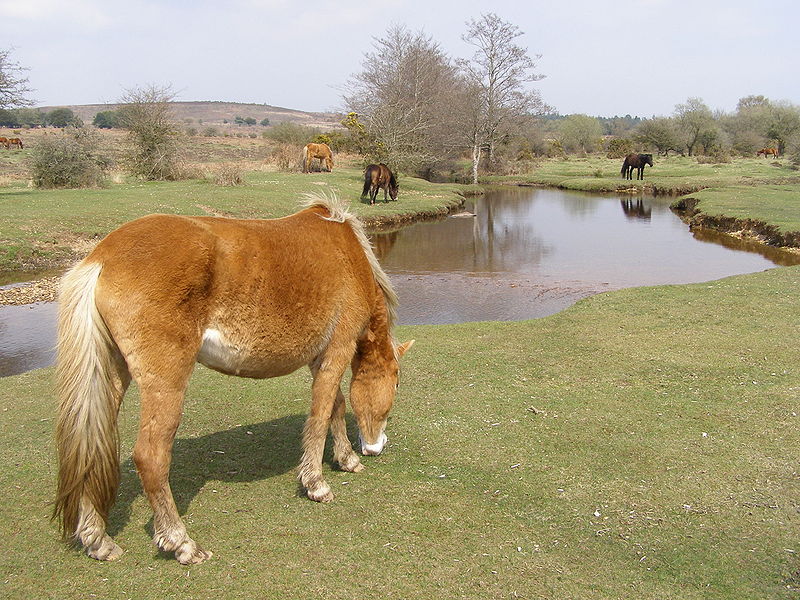
The setting of this novel was largely an area of Southern England in Hampshire called "New Forest." (Only in Britian would something established by William the Conquerer be called "New.") Wikipedia was full of interesting information about the area. Ponies run free and unenclosed by right throughout the area which is actually half forest and half heath. One of the characters is an agister, someone who specifically looks after the forest and thus the ponies.


But there's more than just exotic locale on offer. Another one of the characters is established by excerpts peppered throughout the novel from some sort of report on the care and handling of three boys who, it is eventually revealed, committed a crime. Why this treatise is even in the book doesn't start to become clear until about three quarters of the way through. A mystery within a mystery, it is a remarkable and effective way to flesh out one of the characters.

Ms. George seems to specialize in characterization. This is the 16th novel in the series and the first I've read. The characters are fully fleshed out (even ones which are obviously one-night stands)--and in the case of the detectives, I'm looking forward to getting to know them--and their past--better.

Monday, February 7, 2011

Book Notes:Oprah, A Biography, by Kitty Kelley


I walked into this book three days ago knowing only these facts:

The subjects of Kitty Kelley's works do not tend to like her--or her book very much. (It was a vague impression, I don't know where I picked it up. I don't even know if it is true.)

And about Oprah, I knew the following:

1) She struggles with her weight. I had read the book, Make the Conection, 10 Steps to a Better Body and a Better Life she and Bob Greene wrote together (with a ghost writer, I believe) and I had seen the video they made.

2) She had been molested as a child.

3) She is from the south and had lived with her Grandmother in poverty.

4) She was in The Colour Purple.

5) Her movie project, Beloved, had flopped.

6) She has a school in South Africa and there had been a sex scandal.

7) She is a very rich woman.

8) She works very hard.

I read the magazine from time to time. I have a little book called, "What I know for Sure," and I read an account of what it was like to be featured on her show by scrapbooking maven and Creating Keepsakes founder Lisa Bearnson.

And that was it. I've never read the tabloids. I was not particularily interested in Oprah so I never read any profiles or items on her specifically, except for Living Oprah: My One-Year Experiment to Walk the Walk of the Queen of Talk by Robyn Okrant. (which, actually, isn't about Oprah at all).

I've never seen her show. Not once.

So, I was interested in the facts of Oprah's story--where she came from, where she worked, what she had done to achieve her remarkable success. I've no doubt Kitty Kelley has all of her facts straight and every single duck lined up in a row--the phenomenal research she must have done shows in every line.

But Kelley is unsympathetic to her subject. She seems to warm to her slightly when she discusses Oprah's philanthropy, but she makes much of the fact that Oprah does her giving so publicly. Kelley quotes Oprah's Aunt, Katherine Carr Esters, saying "Nothing is wasted with that girl." And so, with that and what others have to say, Kelley takes what could be considered shrewdness and hammers away at it until Oprah's giving it looks like nothing more than a self-serving aggrandisement of herself.

It becomes relentless. Oprah's seeming preferance for telling "a good story" rather than adhereing to factual truth (a trait my Mother shares. The emotional truth is what matters, not that the event happened with this person or that one, or in this time and place or that) becomes a character flaw in the eyes of her relatives. "She's a liar," they say--and Kelley reports it without anyone offering an alternative interpretation or opinion. This sort of thing happens over and over again.

To be fair to Kelley, I suppose it is part and parcel of what she had to work with. There are plenty of people with grievences and opinions about her who would talk to Kelley. Those who may have been able to provide more balance were likely unavailable to her, either by Oprah's own wishes--and/or the confidentiality contract agreements signed by all the employees and guests of her show.

By the time I finished the book, I had a bad taste in my mouth. Kelley is very careful to present her facts as such and the opinions of others--not her own. But a book is not only what is in it, but what is not, and the resulting slant of the material is not flattering to her subject, to say the least.

I feel robbed. I, who really hadn't had anything invested in Oprah, nevertheless want to believe that people are who they seem to be. Kelley has forever cast relentless doubt upon that perception, upon the image that is Oprah: of the young girl who overcame the tremendous odds of her background and race with her gifts of intelligence, warmth and humanity to acheive worldly success. It's thoroughly modern Cinderella story. But seen through the lenses of Kitty Kelley, it is really the story of The Emperor's New Clothes.

Saturday, January 1, 2011

On Goals


Since today is THAT day, I thought I'd clarify for myself what I've been reading and learning about goals from Danial Pink's book, Drive: The Surprising Truth About What Motivates Us.

According to Pink, who is discussing the work of Carol Dweck, how you view intelligence will determine not only 1) what kind of goals you set but also 2) how you will deal with new situations after reaching your goals and 3) whether you will persevere through adversity.

According to Dweck (according to Pink), goals are of two kinds: performance goals, such as, "I will get an A in French this semester" and learning goals, such as "I will speak French."

Both, , apparently, can lead to high achievement: but the former can also interfere with one's ability to apply whatever you learned on the way to getting your A to new situations. So, theoretically, one can get A's in French class without being able to follow verbal directions on a street corner in Quebec City.

(And why do I say "theoretically"? It happened to me.)

Learning goals, on the other hand, can lead towards mastery. You persevere on that street corner, apparently, when your goal is to improve your abilities. You don't judge yourself as "stupid" and give up (as I did). Challenges are just a part of the journey, not a deal-breaker.

Performance goals arise from the perception that your intelligence is an entity. It is fixed, immutable. If you fail to meet your goal, then, it is because you weren't (fill in the blank) enough. Given enough failure eventually, in order to protect yourself you make your goals small and reachable (or you give up making goals entirely).

And even if you do reach your goals, according to other research, you won't be happy. Pink shifts the terminology and calls these goals "profit" goals. That is, goals which pertain to extrinsic aspirations, such as to achieve fame or become wealthy, once achieved, do not increase your happiness.

Apparently, it's gets worse. achieving these so-called profit goals can lead to more anxiety, greater depression and "other negative indicators." These insights are from research conducted by Edward Deci, Richard Ryan and Christopher Niemiec.

Intrinsic goals, however, goals called "purpose goals" --those oriented towards helping others, and to learn and to grow-- can lead to happiness.

And so here we are.

performance goal--challenge--failure--helplessness
profit goal--achieved--(greater) anxiety and unhappiness

Charming.

Here's the kicker: from what I've seen, (though I've hardly conducted an exhaustive search) most of the literature out there on goal setting will be about setting performance or extrinsic profit goals. It's just in the recipe.

When I gave the link to Lifehacker's post on setting goals the other day, I couldn't help but glance at the "SMART" formula. Take a look. Doesn't it seem like this formula is dealing with performance and/or profit goals? From lifehacker.
  • Specific. Don't just say "Lose weight." Decide to "Lose 12 pounds."
  • Measurable. Instead of "Be better about corresponding with old friends," decide to "Send out birthday and holiday cards to my high school friends."
  • Achievable. "Be the perfect employee/mom/sister/spouse" is an admirable goal, but nobody's perfect, no matter how resolved they are. Make your resolution something that's possible—like, "Improve next year's performance review by at least one grade."
  • Realistic. You've only got so many hours in the day, so make your goals realistic based on what resources and tools you've got on hand. Learning how to milk a cow, for example, is less realistic for someone who lives in the middle of Manhattan.
  • Timely. Since these are New Year's resolutions, set goals you can reach at most within the next 12 months. Giving yourself a "deadline" of sorts will help you figure out where you should be when while tracking your progress.
This goal of mine to "lose weight" for example, could be cast strictly as a Performance/Profit/Smart Goal. That is, I can express it in these terms: It is June 30th, 2011. I feel happy and energetic now that I weigh xxx.

And that, though it follows the SMART formula perfectly, given what Pink has written, would seem to be a goal that, even if it is acheived, may bring me greater anxiety and more unhappiness than I have now.

And you know what?

I think he (and the researchers he cites) are right.

I'll continue this tomorrow.

Saturday, December 11, 2010

The Happiness Project


From Gretchen Rubin's site:
A “happiness project” is an approach to changing your life. First is the preparation stage, when you identify what brings you joy, satisfaction, and engagement, and also what brings you guilt, anger, boredom, and remorse. Second is the making of resolutions, when you identify the concrete actions that will boost your happiness. Then comes the interesting part: keeping your resolutions.

I find it difficult to explain Rubin's book: "The Happiness Project." I just finished it yesterday. I loved it.

Reading it felt like listening to a friend chat about her life. She is warm, engaging, personable, humble, self-aware, honest and straight-forward. It became one of those books I didn't want to finish, because to put it down would feel like losing a friend. Fortunately, she has a blog.

The book is about a year of her life when she decided to become "happier." As she says herself in the book, it's a sub-genre of non-fiction called "stunt" non-fiction. And rather than get upset about it, (as was her first reaction) Rubin writes, she decides to "re-frame" the situation as look at it in a positive light. And that's exactly how the book stops simply becoming a lively and engaging chat, or a memoir and becomes something else. It's not really a self-help book, in the way we understand those things. But it also sort of is; by showing us her own (quite approachable) journey of transformation it lays down the path for the rest of us (though we will all travel it our own way, as we must).

Rubin decided to work on one area of her life per month, and each month is a chapter in the book. (She follows the same scheme on her blog.) To give you an idea of what she explores, here's the table of contents.

  • January: Boost Energy (Vitality)
  • February: Remember Love (Marriage)
  • March: Aim Higher (Work)
  • April: Lighten Up (Parenthood)
  • May: Be Serious about Play (Leisure)
  • June: Make Time for Friends (Friendship)
  • July: Buy Some Happiness (Money)
  • August: Contemplate the Heavens (Eternity)
  • September: Pursue a Passion (Books)
  • October: Pay Attention (Mindfulness)
  • November: Keep a Contented Heart (Attitude)
  • December: Boot Camp Perfect (Happiness)

A introductory chapter and epilogue frame, explain, and follow-up the project nicely. There's also a small blurb about setting up your own project and a fantastic book list.

Within each area Rubin sets herself resolutions to follow, things to do to make herself happier. Along the way, she discovers her own personal truths, (Secrets of Adulthood), some principals to guide her life (Gretchen's 12 Commandments) and some deeper, meta-truths about happiness and its relationship to life in general: The First to Fourth Splendid Truths. (All of which are on her blog).

I am quite tempted to make "Happiness" my one little word for 2011 and using Gretchen's template, transform my life with an eye to becoming happier next year. I think that would be marvelous. But I also have the feeling that that's not exactly my path. We'll see. It could simply be that I am not defining "happiness" broadly enough. As Gretchen's book demonstrates it is a pretty big umbrella.

Nonetheless, reading the book and creating your own happiness project would be a worthy means of self-transformation. I highly (and happily) recommend The Happiness Project to everyone.

Monday, July 12, 2010

Unclutterer: The Week

Day One, Monday:

I read Unclutter Your Life in One Week by Erin Dolan last week.

It is written as though Dolan expects you to de-clutter in seven consecutive days, which is probably impossible for the average person who needs this book. However, in the introduction, she writes much more reasonably, that it took her seven days over the course of six months to unclutter her life. The "seven days" thing, then, is just a marketing ploy.

Nonetheless.

Dolan suggests you tackle your closet(s) and everything related to your clothes on Day One. During the evening you are to clear out, clean and create a "reception station" from the entry way.
The book also delineates things to do related to your office job, but since I don't have one, I'm going to skip those bits entirely.

So.

This Morning.

The Clothing.

I made a list of things which need to be done.

1) Go through the coat closet


and sort into what can be washed at home:


and what needs to go to the drycleaners:


2) Go through my clothes closet

I took out maybe three things, total, even though there are exactly three things I can wear in here. It's my Inspiration Closet.


I went through all the stuff in my drawers and under my bed when I did the season switch just a month or so ago. I'm good with what I did then.

3) Go through the sock bucket.


4) Bag up donations.

Strangely enough, just this morning, I got a call from the charity which picks up items--and they want to come Wednesday! How great is that?

So, there will be these waiting for them.

True confession: I keep an area in the basement laundry room dedicated to donations. This isn't just from today, but the past few months! BUT: there may be even more tomorrow.

next up: Entryway

Friday, December 19, 2008

Smile, and the world smiles with you....

Emotion is contagious. In a way, this is perfectly intuitive. All of us have had our spirits picked up by being around somebody in a good mood. If you think about this closely, though, it's quite a radical notion. We normally think of the expressions on our face as a reflecion of an inner state. I feel happy, so I smile. I feel sad, so I frown. Emotion goes inside-out. Emotional contagion, though, suggests that the opposite is also true. If I can make you smile, I can make you happy. If I can make you frown, I can make you sad. Emotion, in this sense, goes outside-in.

Malcolm Gladwell, discussing the theory Emotional Contagion put forth in a book of the same name by Elaine Hatfield and John Cacioppo in The Tipping Point.

More from another study, this time based on Howard Friedman's charisma test.

He then put all of the high scorers in separate rooms, and paired each of them with two low-scorers. They were told to sit in the room together for two minutes. They could look at each other, but not talk. Then, once the session was over, they were again asked to fill out a detailed questionnaire on how they were feeling. Friedman found that in just two minutes, without a word being spoken, the low scorers ended up picking up the moods of the high scorers. If the charismatic person started out depressed, and the inexpressive person started out happy, by the end of the two minutes the inexpressive person was depressed as well. But it didn't work the other way. Only the charismatic person could infect the other people in the room with his or her emotions.

It's too bad I have to send this book back to the library.

Tuesday, February 19, 2008

More on Homeschooling

It's always difficult to know where to start educating yourself about homeschooling. There's almost too much information out there! But to get an idea of what is possible these three books are an excellent place to start.

I confess I haven't read Susan Schaeffer MacCauley's book. (Yes, she is one of those Schaeffer's). It wasn't in our library system back when I started. It is now, and I have it on request.


From this book, I learned that homeschooling is first and foremost about relationships: the relationship you have with your Creator, the relationships you have with your children and the relationships they have with each other. Protecting, nuturing, developing and growing these relationships is of paramount importance--and a good reason to homeschool no matter what curriculum or method you choose.

It goes beyond just this, of course, laying out an excellent way to approach one's academics. A way that doesn't let them take over your life. A way, I might add, diametrically opposed to the next one.


In this one, a mother and daughter team up to provide not only a vision for what educating your children with rigour and high standards may be like, but they offer specific curriculum suggestions that enable you to teach your children to think in the "classical" way. It is my "go to" book for planning the goals of our homeschool: but it tends to create "school at home" which is highly structured and very demanding.

That's why I'm looking forward to reading this book.


This book sets out the Charlotte Mason method. CM, as it is known in homeschooling circles is also quite rigorous academically, based on learning from "living books" and Nature. From the testimonies of all who follow it, it is more relaxed and the day's work flows from one thing to the next.

One part of me is scared to let go the reins and let things happen "naturally." Yes, partly I'm a control freak, but partly I tend to fall apart without a set structure in front of me and a clear plan to follow. Nothing gets done unless I know exactly what I'm doing. So, we'll have to see if this book will help me figure out what I need to know to relax things around here just a tad. School really doesn't have to look like school, and I'd like to figure out how to do that.

Homeschooling is always a journey, no matter which path you take.

Tuesday, January 15, 2008

Chapter Book Entry: Patchett

(images from Amazon)

Our library has a wonderful system for borrowing new books. On a kiosk, at the front, they set out a selection of new or nearly new books by popular authors. They're called "bestsellers-to-go" and you can take them out for one week (as opposed to the usual three) and you can only take out one of them at a time. You cannot request them, (though there are usually other copies of the book available for request--if you don't mind being #52 (or more) in line) and the late fee is steep. $1/day if you're late returning it.

The best thing about bestsellers to go is the kiosk. Looking at it and perusing the books there feels just like being in a favourite bookstore. And it's free. And that is how I found Ann Patchett.

It was a memoir, actually. I had thought it was a fictionalized memoir. When I discovered it wasn't, about 1/3 of the way through, I couldn't go on. I was willing to suspend my disbelief and read about the splendid, deep, passionate platonic love of friendship, but I wasn't willing to believe it had all been real; the splendid, deep, passionate platonic love for a friend. If it had been real, it would have been too painful to lose, and too painful to read about. So, I haven't finished Truth and Beauty. The author's words were too powerful.

But I did read Run: at a breakneck pace, if you'll pardon the pun. That's one of the ways I know I like an author. If I can't put the book down, then I know that for me, the author is a keeper. (Mystery authors can be exempt from this criterion, per se. P.D. James writes page turners, but they are usually awfully long-winded page turners. Still, I enjoy her policeman, AD. The husband finds her work depressing and won't read it.)

I had to return Run today, so I haven't got any passages on hand to quote and reflect upon. But, I also read Taft and when I closed it last night for the last time, it was with regret.

I'm not sure what it is about her writing that so captivates me and holds me hostage to sleep for two to three nights in a row. Reading her is like dreaming--one floats on the words and forms real but still misty landscapes. People move and talk, things happen but not like in a real dream, without reason or connection. No, things happen naturally, irrefutably -- just like real life. It was just about here, without any warning, that I realised things were going to go terribly wrong:

I watched the two of them go up the street. Wallace watched me watch them. I turned around and put a heavy hand on his shoulder. "This is a big night for me. You learning to do the money. Pretty soon we might be making you a manager or something."
"I wouldn't mind that, " Wallace said. "I've been in the market for a career."
"A smart man like you Wallace. You can come up with a better career than this."

Wallace, you have to understand, is no threat. But reading this I had a horrible premonition something was going to go wrong. And it did (but I won't say what). When did Patchett set me up? When did she hook me? Probably with every word of the previous 210 pages.

Having read the two works back to back, it was interesting to reflect upon their similarities. Both books end with a denouement. Both end with the character who drives each novel wanting to be watched.

Why?

Does Patchett have something to say about people who want to be watched? (And don't we all, just a little bit, have fantasies of being noticed? remarked upon? Well, this is blog world, of course we do.) Or, do people who want to be watched drive things, make things happen because of this desire?

What happens if there's no watcher? What happens if there is and you don't know it, don't want it and find out there is? This sounds creepy, but Patchett isn't. Nor are her characters.

I wonder if her other books are the same--or if these two just happen to deal with the same things?
--parents and their children
--Blacks and Whites living/interacting together
--a sympathetic and tough older male
--boys working themselves out against their fathers
--losing dreams and regaining them
--working out one's identity to oneself within the confines of one's personal past and one's relationships with others.

Taft is Patchett's second novel and it seems like it. It's broader in scope, bigger more devastating things happen than in Run which is tightly focused and wound up tight like a spring. There's also a maturity in the understanding of people and their relationships to one another that just isn't there in Taft. Still, that's no criticsm of Taft. If I hadn't read Run, I wouldn't have noticed. It just feels like Patchett has figured out she doesn't need a large looming canvas for her story (not that it's all that large in Taft): it can be teeny tiny with every line of the characters brilliantly and clearly drawn. It reminds me of some of the single line drawings by Picasso like this one (and which I have always loved. I think I even have it somewhere):

(Isn't that amazing?)

There's nothing remarkable about her writing style. In his book, On Writing, Stephen King says that's how writing ought to be. Quiet and still. It shouldn't call attention to itself. And Patchett's doesn't. It's smooth--like the ice-cold water in the pint glass I carry up to bed every night. And I'm the ice cube slowly melting into it. I float in it, become enveloped by it. Her words and my brain meld, become one. Seriously. It feels crazy to say stuff like this, but it truly is an incredible experience.
Related Posts Plugin for WordPress, Blogger...