Thursday, October 17, 2013

Day 17: Habits

When something isn't working; stuff's piling up, dinner's not being cooked, bills aren't being unpaid, something, obviously, is broken--and it may not be you!

There are two parts to our household systems, as I discussed in this post.

  1. everything in the system has a home, there is a storage solution in place, and
  2. there is a procedure, or method of dealing with the items
I used two examples to talks about the first part, the way we have something set up, (or, in organization-speak, our "storage system") 1) changing out my budgeting papers from a file folder to binder, and 2) changing the form on which I record my meal plan.

Now, we'll talk about the second part: the way we deal with the stuff, our routines or habits.

If something is out of order and it isn't how you have it stored, then you need to ask yourself: am I in the habit of using this system? Have I given myself time to create the habit of using the system consistently?

Do you know what actions you need to take to maintain this system?

Here's an example:


I want to make this paper system work for me. It has actions associated with it which I need to do in order for it to work:

  1. The top tier holds actionable items with a deadline. I also holds the days mail until I deal with it. (Comingling these two categories does not work. Perhaps I ought to find another home for today's mail). I need to check this daily.
  2. The second tier holds actionable items which do not have a deadline. I should check this every few days.
  3. The third tier holds reference items which need to be put away in their various reference spots (unless they are items pending.) These need to be checked once a week.
  4. All of these are items which need to be filed and this pile is already higher than I would like. I need to handle this weekly, as well.

If the area you are dealing with (like a linen closet or a cupboard where things are generally stored) the steps are essentially the same:
  • identify how the space becomes disorganized
  • then identify what you need to do in order to either prevent it from happening (i.e., have fewer bed sheets so the stack doesn't topple when I remove a set) or identify what you can do to address the situation before it gets out of hand.

Now the next thing you need to do is set a time to do those actions. Setting a time, or deciding when you will take action gives you a greater chance of actually doing those things than not setting a time. So, in my example above, every few days is vague. Thursdays and Tuesdays ought to be enough. Desk day is Thursday, so that takes care of once a week.

Scheduling when I will deal with the paper in the trays is one of the first steps to making it a habit. But a schedule is not enough. How will I remember to check the papers every day, let alone on Tuesdays and Thursdays?

A habit needs a cue (or a reminder, or a trigger), the routine, and a reward.

We'll talk more about that tomorrow.

ETA: You can catch all the posts in the series here.

Wednesday, October 16, 2013

Day 16: Rabbit Trails to Mini-Zones

It can be difficult to stay organized if you aren't quite organized in the first place.

For example, let's say you need to write a cheque to order those school photos. Do you know where the photo order form is? The chequebook? If you record your cheques in a register, is that handy?

Here's a sweet little bill paying centre with a spot for keeping receipts. Details here.


What about finding your cell phone--and making sure its charged?


A charging station made from a ribbon box. Details here.


Can you wrap a gift easily?

details here.


Do you have to go on a whole-house scavenger hunt sometimes to gather the things you need to get the job done? In her book, The House that Cleans Itself, Mindy Starns Clark calls these journeys you take from room to room your rabbit trails. Her advice is to create a "working station." Aby calls them "mini-zones."


A meal planning mini-zone from allparenting.com

Whatever they're called, they are essential to being able to stay organized. Everything needed for a particular task is collected into one container (or area) and stored where that task is performed. If you can't store the items where you do the task, then the container should be portable.

The ultimate office in a bag. All the awesome sauce here.

To create a mini zone, gather all the things you need to perform the task at hand. If it's fairly complicated (like a diaper bag in which you are going to keep everything you need for the baby while you are out and about --include a checklist to run through).

Then, choose the most appropriate container.

  • Should it be open or closed?
  • Clear or opaque?
  • Portable or Stationary?
  • Horizontal or vertical?
  • Does it need to be visible to the family or can it be shut away behind a door, or in a drawer?
  • Make note of any space constraints you may have where you want to put your container. Are there any dimensions you need to be aware of?

A mini-zone out and open to all should be as attractive as possible.


Isn't that gorgeous? If you need any further ideas for your pet supplies, here's a great post  from I Heart Organizing.

Do you have any rabbit trails that would benefit from a working station or mini-zone?

ETA: You can catch all the posts in the series here.

Tuesday, October 15, 2013

Day 15: Tweaking a System: Meal Planning

Note: For those of you with apps and smart phones, this is going to seem quite archaic. But as you read through, see if you can think of any systems you have with "unusual" containers--which may or may not be working.


In the middle of planning our meals.


A system can break down in one of two ways:

1) you stop using it, or
2) the way you have it set up doesn't work for you.

Yesterday we talked about how I changed the way I stored my budgeting materials: a folder didn't allow me to separate the different pieces of paper I needed to access to pay my bills and keep track of my spending. That was a very clear example of changing the way it was set up for me by changing the storage container.

But meal planning? Other than talking about my cook books and how I have them on a shelf, there's not much else to say, is there?

Well, maybe. But meal planning is essentially pulling together all sorts of different kinds of information in order to decide what to eat for a set period of time. (FYI: Simplify 101 offers a menu planning course. I have not taken it.) Then, you take your meal plan and break it down into a shopping list.

I love forms. I see them as "storage containers" for information. So, a change in meal planning requires a change in forms. (For me, anyway. I think I'm probably a little strange in this regard.)

I used to plan by the month--so I needed one form  to capture all the meals for the month. I used a monthly calendar which I printed from the computer.

I used that for a while, but it was a lot of wasted space.

Then, I was thinking about starting work. I wanted a way to take my schedule into account: so I fished out an old form Aby had provided for us. I forget in which course it was originally offered. (Time Management, maybe?)

I tweaked it and made it my own, but the essential idea is hers: meals on top with a place to record activities to the side of each day, and a place for the shopping list below with items grouped by category. I added a place for notes on the right hand side.


Now, the form can completely capture the entire procedure of meal planning, for me. As well, all I need to take to the store is this one form: before, if I wanted to know what meals we were having, I had to take along the shopping list and the menu plan. I used to do my grocery shopping with a clipboard.


Looks like I need to change the heading for produce with frozen foods--I need more room to write!

Tomorrow we'll move on to the other side of this equation: habits!

ETA: You can catch all the posts in the series here.

Monday, October 14, 2013

Day 14: Tweaking a System: Paying Bills and Keeping Track of our Spending

Happy Thanksgiving, fellow Canadians!


Yesterday, I defined a "household system" as being made up of two separate and distinct parts:
  1. everything in the system has a home, there is a storage solution in place, and
  2. there is a procedure, or method of dealing with the items.
A few months ago, I noticed I was having trouble paying my bills on time. My procedure for collecting the bills was to let them pile up on the top shelf of this mess:

This is how my paper system looked in July.  You can see how my bills might have become a little lost.

I was supposed to put my bills in our "budget" file folder. It lived in this:


Worse, the budget file, the place where I kept not only the unpaid bills, but all the papers related to tracking out income and our spending had gotten too big and difficult to handle.


I had too many different kinds of paper to keep track of and the file wasn't letting me sort them effectively. As well, I was afraid of papers spilling out of it every time I took it out to use it.

When I saw Toni Morrison's Budget Binder series, from A Bowl Full of Lemons, I knew that a binder would be perfect for me. So, I took one off my shelf, emptied its contents and set it up anew. I kept the cover insert I created ages ago.


Inside:

This pencil case holds all the tools I need to work:
  • highlighters, pen, pencil, eraser
  • post-it notes
  • rular
  • calculator
  • cheque with my own pre-printed register.


Right away you find a clear page pocket. This is where I keep unpaid bills, now. (I slipped in some class notes in order to preserve some privacy.)

Next, my five tabs:


followed by the monthly tabs:


The five major categories are:
  1. accounts--a most thorough listing of all the financial accounts with which we deal. This was an excellent suggestion from Toni's series.
  2. income--a place to keep track of our income, by month.
  3. due dates--this is a form where I have written out when all of our bills are due. I've divvied it up into two sections: those automatically withdrawn by the bank (about 60%) and those I pay, myself.
  4. credit card--this is not in Toni's series. I like to keep track of our spending by credit card and ideally, pay it off weekly.
  5. budget--this is really just an introduction to the monthly tabs. Behind each one for the month, I keep our monthly cash flow plan along with the pages I print off from our bank account to track our weekly spending.
It couldn't be easier, really.

When a bill comes in the mail, I put it in the pocket. On Thursday, my "desk day", I do all that I need to do to record our spending for that week, pay our bills and then file them in the "bills paid" folder (still in that black mesh thing, above).

This system wasn't working for me for a few reasons, but mostly because that file folder was inadequate for the job. The binder is easy to pull out and use: it's like having my own little budget mini-station.

ETA: You can catch all the posts in the series here.

Linking up to the Organizing Party at Org Junkie:

Sunday, October 13, 2013

Day 13: Fixing Systems: Diagnosing What's Broken.

One of our household systems: The Family Communications Centre. Believe me, it's a whole lot prettier than the laundry room, right now!


We are going to leave the problems of perfectionism and turn to looking at our household systems: those storage solutions and habits we have in place which make our every day lives easier. That is why we want to stay organized, isn't it? So we can do other things like read books and bake cookies.

To say "there's a system for that" what I mean is
  1. everything in the system has a home, there is a storage solution in place, and
  2. there is a procedure, or method of dealing with the items. (We want this to become a habit.)

This is so abstract. Think of a regular household task like paying a bill.

You have a place to keep the bill until it is paid and a place to keep the bill once it is paid. This is your storage solution.

Your routine of finding the bill, paying it, and then filing or shredding it is your procedure, or method of dealing with it.

It was like a long line of little light bulbs popped in my head when I first heard Aby make this distinction. I immediately realised that even though it wasn't working, the family communication centre I'd set up last year was fine: it's just that we had not yet developed the habit of using it. (Oddly enough, making it pretty encouraged my daughter to use it.)

Here are some other systems which you may or may not have set up in your home to your satisfaction:

Coming and Going
Family Communication Centre
Handling Mail (and other incoming paperwork)
Paying Bills and keeping track of your spending
Laundry
Meal Planning
Shopping Lists and Errands
Calendar and Managing Appointments
Managing Projects and To Dos
and so on.

How do you tell if it's the storage solution or your routine which isn't working?

Well, did it ever work? Was there a time when it did--but you just haven't used it in a while?

If the answer is yes, then you need to establish a habit to use it--and I'll cover habits later in the series.

But if the answer is no, then maybe you need to change something about how you are storing the items you use. Shift papers from a file to a binder for instance, or set up a portable reading basket, or put laundry hampers in every bedroom and the bathroom. Tweaking the storage "solution" can make the whole process of creating a routine or habit more fluid and intuitive. 

I'm going to discuss some systems from the point of view of getting them set up right: that is, getting the stuff figured out over the next few days. Then, we'll turn to the habits we need to create to use them effectively (as well as staying organized, generally). (I'm listening to Charles Duhigg's book, The Power of Habit: Why We Do What We Do. This is my second time through the book. I highly recommend it.)

Tell me, do you have any systems in your house? Any not working very well?

ETA: You can catch all the posts in the series here.

Saturday, October 12, 2013

Day 12: Be Kind. To Yourself.

Here's a shot of the playhouse/shed in our backyard. Fall is my favourite season.
 
 
I had planned to write a good, long post all about how much this one thing has changed my life. (I write these posts the evening before posting date.)

But I'm too tired.

As a perfectionist, I was constantly berating myself for being so inadequate. Slowly. slowly, over many, many years, I have learned to speak to myself as I would speak to a friend--especially when I am hurting.

You can't stay organized--or indeed accomplish much of anything when you're putting yourself down and berating yourself.

Trust.

So, this post will be short. I've been up since 4:30am and it's not even 6pm--and I'm more than ready for bed.

I'm going to be a friend to myself and just chill.

Peace.

 
ETA: You can catch all the posts in the series here.

Friday, October 11, 2013

Day 11: Accept Help

It may seem as though we took a small detour from dealing with perfectionism, but we didn't. Not really. Sometimes, problems with finishing things have nothing to do with perfectionism, and sometimes they do.

But there's no doubt in my mind that finding it difficult to ask for help is definitely a symptom of perfectionism. I have a terrible time with this one.

In fact, I almost couldn't even write this post because with every single example I could think of lately where I asked family members for help, all I could think about was how poorly they did the jobs I asked them to do.

And I don't want to talk about that on a public blog.

But, working on the back entry way, today, I realised I did have a recent example of asking for help--and it's working out wonderfully.

On September 23rd, I wrote a post as part of the HTCI (The House that Cleans Itself series--which I haven't forgotten about!) about our back entry way. In it, I mentioned we were going to look after all the scratches and nicks and cracks in the walls and ceilings in order to spiff it up.

Then, I posted this:


My husband is meticulous. He's careful. When he wants too, he can hyper-focus on detail. I am so grateful he took over the project. It was a lot of work--and it needed his patience.

Let's get re-acquainted with the back entry way shall we?

Here is what it looks like standing outside on the stoop. To the right are the stairs to the kitchen.


Straight ahead? The stairs to the basement.


The bottom edge of those walls were in rough shape.

Someone drew this flower on the wall ages ago to indicate where the pull cord was for the light in the laundry room. I coloured it in last Spring.


So, too, was the outer corner where the stairs to the kitchen meet the stairs to the basement.


The wall beside the door needed a lot of patching. Look over the door: that was a particularly nasty spot.


The door itself would swing open of its own accord and give the wall a bang.


I found something for that right away. Fortunately, it was peel and stick. I'm not sure there was enough wall left for screws to work!

I also found a plastic "short L" shaped piece of molding--it was made just for edges like these. It came with its own adhesive strip, fortunately, because I wasn't able to track down any liquid nails.

Here's the outside corner with its new edge:

It looks wonky here--and though it might be wonky, I don't think it is as wonky as this!


And the bottom of the wall:


You can also see the disk I stuck on the wall to protect it from the door knob.

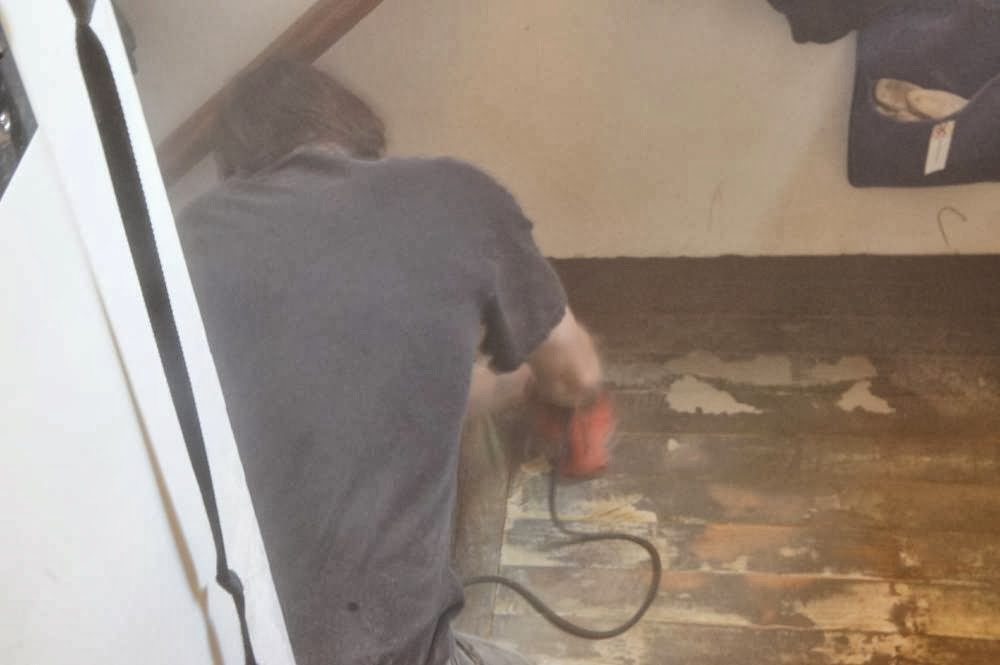
Yesterday, 16 days after he started patching and sanding, he told me it would be OK to start painting, Only -- would I sand "that little bit in the corner."

I sanded, but obviously I had no idea what he meant because when he got home--after I had washed the place down and cut in-- he told me the area he'd mentioned hadn't been sanded!

So, last night, he sanded, again, (though this time by hand) and left me to do the rest.


But who cares?

All it needed was a quick once over with the vacuum, a quick swipe with the cloth and I was ready to resume painting.

It's kind of unfortunate that the best example I have of accepting help has to do with a large project. Staying organized is all about doing the little things--and asking for help with those things (and accepting it cheerfully and NOT with a critical, judgemental spirit) are what will help you stay organized. All I can say is: I promise to keep working on it.
 
 
ETA: You can catch all the posts in the series here.    

Related Posts Plugin for WordPress, Blogger...