Tuesday, October 8, 2013

Day 8: Embrace the Bite, Part 2.

So, you've started that big nasty project by taking the smallest possible action. Now, you need to get the rest of that beast done.

A great way is to bite size your project. It's a wonderful way to keep yourself moving forward on a complex or time consuming project.

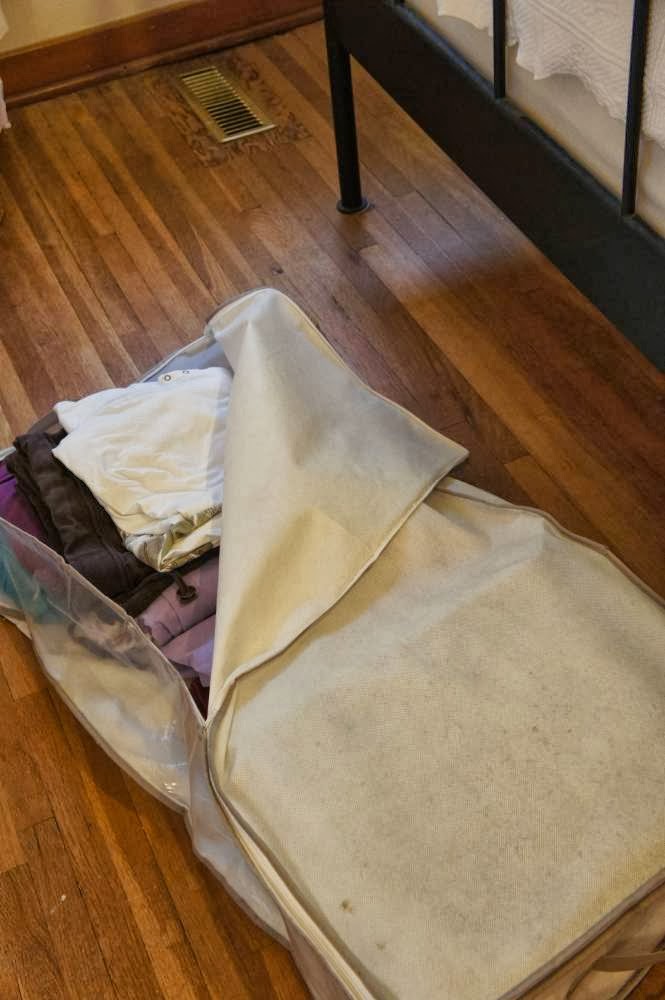
Right about now it's time for me to start thinking about switching out my summer clothes for fall. This year, I've decided to break down the project into small bite-sized steps. That way, I can take any of those steps whenever the opportunity arises, instead of trying to fit in a big chunk of time to do it at this busy time of year.

What does switching out the summer for winter clothes involve?

Essentially, you're just putting away the summer stuff, taking out the winter stuff. As you do that, you'll donate anything which you no longer like or need and take a quick inventory to see if there's anything you need.

Here's what that looks like.

Outdoor Clothes:

1) Take the winter coats to the cleaners (if, like me, you didn't do this in the Spring when you really should have) or wash them.

2) Make sure everyone has winter boots that fit and aren't falling apart.

3) Put "winter boots for _______" on a shopping list.

4) Go through scarves, hats and gloves and make sure there's enough for everyone. Don't forget to check coat pockets!

Indoor Clothes:

1) Put warm weather tops and bottoms into storage as they come out of the laundry.


2) Grab the cold weather tops and bottoms when I'm putting away the summer stuff and put it into my dresser drawers.

3) Go through my closet and see what fits and what doesn't and ascertain what I may need. Do this 15 minutes a day until I'm done. (In truth, I'm going to skip this. I know what I need.)

4) Go shopping for whatever we need. (You could break this down into bite sized pieces, too, if that's convenient for you, say, picking up an item or two every few days after work.)

I find it really helps if I write it all out like this, too, so I can check off what I've done as I go. I love those check marks!

Does it seem more overwhelming to see it all written down like that? If it does, just take a post it or something and cover up the next step. Focus on the step right in front of you and just do that. If that seems to complicated, it probably is! Simplify it as far as possible until it would feel silly not to do it.

Is there any task you're currently facing which would benefit from being bite-sized?

ETA: You can catch all the posts in the series here.    

Monday, October 7, 2013

Day 7: Embrace the Bite, Part 1

Procrastination Remedy #1


You know how you eat an elephant?
One bite at a time.

Ok. Fine. But it is still a pretty big job. It's still overwhelming.

Do you need to know how to start eating an elephant? And what if you don't really want to eat that elephant? I mean, who likes elephant meat?

Take the smallest bite you possibly can. And that is all.

I first read about this idea in a column by Martha Beck in O magazine.

I think Beck's example was cleaning out a closet. Take the smallest possible action, she advised. Like, open the door. That's it. Pat yourself on the back. You have got this project started!

Sometimes, that's all you need to do to get going. I was feeling utterly overwhelmed by everything I needed to do today. My front entry way has been bothering me for the past couple of days.


I decided that the smallest possible action I could take was to clean off the shelf.
So I did.

Those papers still on the shelf are our auto insurance cards and need to be put in our wallets. This is their "home" until then.


That's the bite.

The great thing about the bite is: it's enough. Really it is.

The other great thing about the bite is that sometimes, sometimes, you feel like continuing.
Like I did.

It's too bad the mirror reflects all that mess in the kitchen!

If you're having one of those days where you just need to throw the ignition switch, just begin. Take the tiniest bite out of that overwhelming monster.

Pay yourself on the back.

That is all.

(But should you feel like continuing, if the motivation hits after you have taken the action, (as it will, sometimes) then by all means....)


Curious: What's the strangest meat you have ever eaten?

ETA: You can catch all the posts in the series here.    

Sunday, October 6, 2013

Day 6: Time Dreaded Tasks

Yesterday, we talked about setting the timer for 15 minutes and letting it run down while focussing on one task. It's a great way to tackle tasks you don't have time to finish, may never, actually be finished, (laundry, anyone?) or tasks you dread doing.

Another way to tackle those dreaded tasks, though, is to time them. Just how long does it take, anyway?

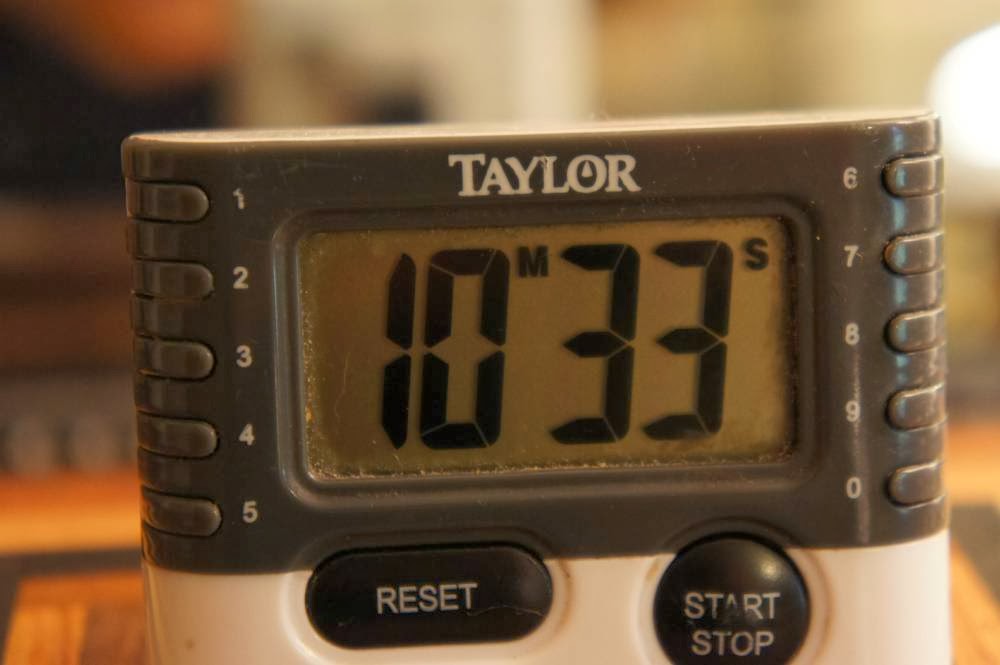
I put off putting my new duvet cover on my duvet. It takes some agility--climbing inside the duvet cover to match up the corners is no feat for the inflexible! So, I timed myself.


That wasn't too bad, I suppose.

Even better, though, was putting away this basket of laundry.


I was thrilled it only took 2 minutes and 47 seconds.

And clearing this chair?

sorry for the blur!


It is great when something takes less time than you think it will. You now have a stick to beat back that dread. But even if the task does take a long time, like my duvet cover, you still have useful information. We'll talk about simplifying tasks later in this series, too.

Are there any tasks you dread doing?

If you choose to time any as you do them, today, feel free to let me know how long they took in the comments.

ETA: You can catch all the posts in the series here.    

Saturday, October 5, 2013

Day 5: The Magic of 15 Minutes.

This is my best friend.


In fact, for years, it was the only way I could tackle any of my housework. I'd set my timer for 15 minutes and focus on one thing. Then, I'd set it again and do another thing. I'd go through whole days like that.

Remember we talked about what "being organized" meant to you? If it's finding something--anything--in less than two minutes as Nicole wrote, then I imagine that picking things up and putting them away would be a pretty high priority.

But what if the last few days have been an absolute whirlwind and you haven't had time to blink, let alone put things away?

So you have a disaster on your hands--and you have five minutes, ten, fifteen to pick up before you have to do something else.

Do you say to yourself, "I can't possibly get it all done. I'll wait until I can."

I used to say that, a lot. It was part of my perfectionism. If I couldn't sweep AND mop the kitchen floor, there wasn't any point in sweeping, was there?

If I couldn't wash ALL the dishes in one go, (and it is sometimes impossible to do that without a volunteer dish dryer) then why wash any?

If I can't sort and put away all these papers in 15 minutes, why bother?


So, I decided, just for the sake of this blog post, that I'd see how far through this stack of papers 15 minutes would take me. (Believe me, I am never motivated to tackle paper. Never. We'll talk about not having any motivation soon, too.)

Ta Da!

I swear it only took 15 minutes--and not all day as the lighting here would suggest. It just took me that long to get a decent picture.


I sorted out the coupons to clip--and put them in my coupon binder.
I filed some papers right away and put away page protectors.
Anything requiring scheduling, I tucked into my planner.

What's left just needs filing--except that I haven't got files for most of it.

Remember: progress, not perfection.

I see another 15 minutes in my future.

ETA: You can catch all the posts in the series here.    

Friday, October 4, 2013

Day 4: Perfectionism. A Dirty Word?

Hi. My name is Alana and I am a perfectionist.

In truth, I am a recovering perfectionist. I started my recovery about a dozen years ago or so--the first time I found Flylady. She was the first to make the connection between my tendency to want and expect perfection--and the reality of the chaos around me. Back then, under the influence of full-blown perfectionism, my house was a complete catastrophe and I was utterly miserable.

I based my expectations for housekeeping on my hardworking grandmother. I lived with her for many summers and once for half a year. She kept a garden, she washed her dishes by hand several times a day, she did laundry every day, she vacuumed every day (sometimes more than once, especially if I'd made a mess). She also had about three part time jobs-- one as church secretary, one with a government office, and one as an assistant to my grandfather at his part-time job as a process server for county court. (He also worked full time). You get the picture. She never sat down-- and her house was always company ready. (And she had company--couples came over to play cards every Friday night.)

But what I missed was that when I stayed with my grandmother, she had only one child still at home--and she was ten years older than me. I never saw her run her house with small children and all their toys underfoot. She didn't drive. She never ferried her children all over the city to various activities. When I lived with her, I rode my bike to the town swimming pool every day in the summer. I had a paper route and choir practice--and I was expected to walk, no matter what the weather.

In short, our lives were totally different: yet I expected myself to be just like her. It has taken me a long time to figure all this out. In the beginning, all I knew was a tremendous pressure to be different, to be better.

Grandma didn't have an Expedit, either.


Symptoms of Perfectionism:


1. All or nothing thinking.

I have long suffered from this. In psychology they call it "catastrophizing." You know, that one thing goes missing and you say to yourself, "I'll never find it. I'm always losing things."  Either something is perfect--or it is terrible. Either I am a good housekeeper--or a failure. Projects aren't worth starting unless you can start and finish them all in one go. That's impossible with long complicated projects, like switching out the summer for the winter clothes, painting a room, or cleaning the fridge--so they don't get done. If I can't see my clear to the end of a complicated project--if I don't know some of the steps to take--I tend to put it off. I still do this.

2. Procrastination.

Not all procrastination is caused by perfectionism, but some of it is. Most telling, I always tend to leave that last 10% of a project incomplete. Once it is done, you see, it can be critiqued and judged--and I already know it is not perfect.

3. Difficulty with delegating.

A perfectionist finds it difficult to delegate--though I am working on that one! I have young teenagers and they need to learn to do things for themselves, so I am doing my best to let them do things (and bite my tongue). Nothing is quite done to my satisfaction--but I have decided to learn to live with it.

4. Fear of making a mistake.

Fortunately, my grandmother always laughed at herself when she made a mistake. Making mistakes was just a part of life, so I was fortunate to escape this symptom. It can paralyse you when you're decluttering and making decisions about what to get rid of. The remedy for this is to ask yourself: "what's the worst that could happen if I got rid of this?" and listen to the answer.


Perfectionism isn't all bad. It has its place. My ability to pay attention to detail means that I can plan an entire series like this, catch patches on a wall that need further sanding before we paint, and help my Mom organize her entire house, room by room.

Over the next few days, I am going to talk about how I have managed to deal with perfectionism when it gets in the way of being organized.

Are you a perfectionist?

ETA: You can catch all the posts in the series here.    

Thursday, October 3, 2013

Day 3: Integrity: Honouring Your Comfort Zone

Integrity: Being true to yourself. To honour your own needs.


Do you know your tipping point? You know, that point where the mess goes from "OK, I can deal with that later," to "omigodwhathappenedherewhatamesswheredoIbegin?"

Aby Garvey calls this knowing your comfort zone. It is a continuum and it can be different for different areas of the house. It can be different for different seasons of our lives. (Bionicles and Polly Pockets used to throw parties with Lego in my living room. Used to. No more! (I was sitting here thinking how great that was when I glanced over into the living room and saw jackets, shoes, backpacks, and various bits of electronics.....)

The continuum ranges from "very cluttered" to "magazine ready." Let me illustrate, using my own kitchen table.

Very cluttered:

This is so bad, there's no possibility of eating together as a family tonight. It would take far too much time to clear off. This was my table on Sunday. It made me sad.

Slightly Cluttered:

This was taken sometime this summer. This would probably take about 15 minutes or so to clear off. We ate outside a lot this summer, though, so I got into a bad habit of letting things pile up here.

Real Life:


This is how the table looks this morning. (Those are chips in the laminate--not blobs of chocolate!) These things are here because we're sanding and painting our back entry way which is just to the left of this photo. Hubs and I ate together here last night. The kids ate in their rooms. (sad face.)

Company Ready:

This is a photo from the Home Tour in June.
There's one more spot on the continuum: Magazine Ready.

There's no photo of the table "magazine ready" because unless a magazine actually comes to my home to shoot it, it won't ever be "magazine ready." And that's totally fine with me. I don't need that kind of pressure on me. (No one does.)

My personal comfort zone? As far as the kitchen table goes, somewhere between "real life" and "company ready" is where I like it to be.

There is another area of my kitchen, though, where my standards are higher. Unfortunately, it is also more difficult to keep clean and tidy.

My counter. Specifically, the area beside my kitchen sink. (We don't have a dishwasher.) When this area is out of sorts, it can cause me to feel paralysed. Quite quickly, I can fall into the pit of thinking "there's no use cleaning up."  (When my kids were littles and my whole house looked something like this, everywhere, all at once, it was difficult to believe it would ever change. The paralysis and hopelessness were intense at times. I have, fortunately, learned to cope with those feelings and I'll talk about that later in this series.) But when this area looks like this: I can still get anxious.


When it is "company ready" all is right with the world and I feel intense satisfaction. I smile. I'm cheerful. (But don't ask me to make you a sandwich.)


Mary Starns Clark, in her book, The House that Cleans Itself, calls an area like this: one that causes an intense emotional reaction, your Home Based Zone. It could be anything. The area under your bed, perhaps. A bathroom. Papers.

It helps to know what it is: that way you can prioritize your time and effort. Looking after it honours yourself and your standards. Looking after it is a way of looking after yourself. And that's important. More important than a "magazine ready" house.

What's your "home based zone?"
Do you know your clutter comfort zone for each area of your house?

PS: This series is roughly based on what I learned in a course called "The Secrets of Staying Organized" by Aby Garvey at Simplify 101. It is being offered again in November and it is currently on sale. I am not being compensated by Simplify 101 for this series--in fact, I doubt they even know I'm doing it. But I just wanted you to know in case you're interested.

ETA: You can catch all the posts in the series here.    

Wednesday, October 2, 2013

Day 2: What's it mean, anyway?

Perhaps I should have called this series, "The Philosophy of Staying Organized." I promise we will be getting to the nitty gritty soon.

We need to know what we mean by "organized." When you're organized, is your house, purse and car "magazine-ready?" Or is it a more relaxed than that--and being organized is a feeling of calm --you are on top of things-- even if the house isn't quite ready for a visit from the Queen?

Or does "being organized" mean you can make a meal without working around stuff on the counters, you can find that piece of paper at a moments notice, or you know where you keys are?

via: pinterest

This is organized: everything has a home and the space is maximized as well as being easy to use. Hooray for function!

But this, too, says "organized" to me:

via: pinterest

This says: come and relax. Everything is as it should be. This is how "being organized" feels to me.

When everything is as it should be at my house--

  • the dishes are drying
  • the bed is made
  • laundry is in progress
  • the bathrooms are clean
  • the house is picked up
  • the floors are vacuumed and swept
  • I know where those papers are (whatever they are. There's always some you need to put your hands on right away!)
  • and everything is put away.

Sort of how things were when I had my house tour in June!

What does "organized" mean to you?

ETA: You can catch all the posts in the series here.    
Related Posts Plugin for WordPress, Blogger...