Showing posts with label habit. Show all posts

Saturday, February 20, 2016

Week 5. Cleaning The Bedroom: The Joy of Habits and Routine


This last week, the challenge at A Bowl Full of Lemons was to declutter and clean the master bedroom.


It was basically a free week.

I cleaned the room within an inch of its life during the January Cure--rotating the mattress, changing the linens--I even took the curtains down and washed them.

Since then, I've been following the 20 minute task for 30 days cleaning schedule from AT: and because of it, I've cleaned the mirrors and the inside of the window. I've also changed the sheets, dusted and swiffered twice. Each. The bedroom has never been so clean! The only thing I did especially for this challenge was to wash the sofa cover and pillow covers on this couch. (It's essentially the dog's bed.)


But I also have a daily routine which I've developed over time--and it keeps the bedroom humming along pretty well.

It starts when I go to bed--and it starts with this chair.


I love this old chair. I found it almost exactly like this at a flea market. Chris has had to reglue the legs back on more than once.

The purpose of this chair might surprise you.

It is not for sitting. It is much too frail for that.

This chair is for my clothes.

I usually just drape my clothes over the seat. I'll hook my bra onto the back. My PJ's are right there--hanging on the back of the bedroom door.


In the morning, after hitting the alarm, I put on my slippers--and leave the room. I don't come back until it is time to get dressed--and that's when the magic happens.

I make the bed.


I really enjoy making my bed. It's a simple thing to do: it's quick and it makes me happy twice over: Right when I make it, of course--and then when I come back to it hours later and crawl in.

After I make the bed, I get dressed. (Sometimes it is the other way around--like when I'm wet and wearing a towel after my shower.) Either I put on the clothes on the chair--or I put on new ones. But I tidy up the chair. The clothes have aired--either it is time to put them away--or throw them in the hamper.

I have one drawer in this chest.

and all the drawers in this chest.


Then, I putz about and pick up any trash on the floor. (The dog pulls it out of the basket.) I hang up our pj's (unless, rarely, hubs has hung his up already).

I put in my earrings.

My daughter made this colourful piece and I love it! This is the best way I know how to make it useful.

Then, I gather up any extra water glasses or other dishes, grab my socks and book if I'm working that day, and then leave to do my make up.

It's a little tidying routine--kicked off by making the bed.

Unless my husband is in it.

My husband has been home since January 11th with vertigo. He's often still in bed when it is time for me to get dressed. So, I can't do my little bedroom routine.

In fact, that's how I became aware it is not just a routine--but a habit. I haven't been able to do it --and I've noticed! I've missed it.

I'm not sure when I started this little routine--it's been years--so I can't tell you how long it has been since it became a habit. I am just grateful it is--and I wouldn't have noticed if I hadn't been prevented from being able to do it.

Funny that it works that way.


Next in the series is the Master Closet. Again, thanks to AT, I don't have much to do there, either.

Previous Posts in this series:

Week 3: The Dining Room is Cleaned
Week 4: The Launch Pads (or Entryways).


****************************************************
Want to know how this all turns out? Have these posts delivered right to your inbox!


**************************************************

Monday, December 29, 2014

New Habit: Monthly Review

Today, my ten minute tidy took an hour.


And that's great!

When I started this habit, I was looking for something to help me keep my house under control. I picked it because it seemed intuitive to me that after spending 10 minutes walking around my house--even at its tidiest--I would find something which needed to be done. In truth, the habit wasn't so much "tidying" as it was 10 minutes of focused action-oriented attention on the house.


For a habit to be successful, it needs a trigger and a reward. My trigger was finishing my first cup of coffee in the morning. At the beginning of the month, I set up a sticky note on the coffee maker to remind me to do it (as I reached out to pour that second cup.)  I never did figure out a reward. As for tracking my habit, I decided to use a simple calendar of the days of the month and mark an "X."


Observations:

I performed my habit 28/29 times.

Obstacles:

First, and most disappointing, a ten minute tidy--even when I do it every day--is not sufficient to keep my house picked up. It kills me, but it is only a start. In truth, I'll do whatever needs doing for that ten minutes--sometimes whatever is easiest, sometimes, whatever is most urgent--there's always something to do--and something always left undone. I need to make my peace with that. It won't be too hard, really. I just need to remember something is better than nothing--and it all counts.

Second, as you know, about half way through the month, I struggled with resentment. Apparently, having negative thoughts about the habit (thoughts that would justify quitting) is normal. For me, part of it was resenting the people who make the messes and don't clean up after themselves, the other was because of the way I'd set myself to do it. It interrupted my morning.

The first. I will figure out how to deal with separately. As for the second, I've decided that it makes sense to adhere to that schedule on the days I am working. Mostly, I am afraid that if I promise myself to do it later, I just won't--as I didn't on the day that I missed. However, on days I do not have to be at work and can enjoy some leisure, I've decided to wait until I am "ready" --however many cups of coffee later that may be.

That's exactly what I did this morning--and why I spent an hour in my room picking things up, putting things away, folding laundry, making the bed, dusting, and swiffering. It was most satisfying to be able to devote the time to making my room the clean, calm sanctuary I need it to be.

I am going to continue with this habit.


So nice.

Saturday, December 20, 2014

Consequences

I enrolled in Leo Babauta's Sea Change Program this month to work on creating habits.

For my habit, I picked 'tidying the house for ten minutes.' In reality, I've been doing various housekeeping related things, so the habit I am trying to form is better expressed as giving the house some focused and concentrated action oriented attention.

My trigger to begin is finishing my first cup of coffee. I put a reminder on the coffee pot. Yesterday, I slept in and did not even have a second cup of coffee--let alone ten minutes to tidy up. But boy-o-boy--did the house ever need it!

I figured I do it later. But as things do, "later" turned into "never" and there is a consequence for that. Leo suggests that we institute an "embarrassing but fun" consequence for missing a day. I haven't been able to figure out the "fun" bit--but I've got "embarrassing" ready.

The kitchen table:


and because I do have some pride. (Ok, a lot.) Here we are now:


So that this exercise isn't merely self-flagellating, maybe you can help?

I am having a couple of problems (both mental):

1) Timing. As I mentioned, I do this after my first cup of coffee and before I pour the second. Often, though, I am in the middle of something at that exact moment: writing a post, or reading something, usually. It is quite a wrench to pull myself out of what I am doing and start picking things up. It is a good time, however. Easy to remember--and--as long as I don't compress my morning--easy to do. It fits well into my morning routine. Maybe I just ought to just suck it up and do it (as I have been doing)? I have managed to do it 19 out of 20 days so far. The only day I've missed was yesterday.

2) Resentment. I wish it weren't true, but on some days I have a lot of resentment towards the other people in this house whose messes I am constantly cleaning (or so it feels). I am also resenting the interruption in my morning--as I mentioned above.


Any thoughts? Ideas?
Have you struggled with forming a new habit?


Wednesday, January 15, 2014

Mid-Month Goals Update


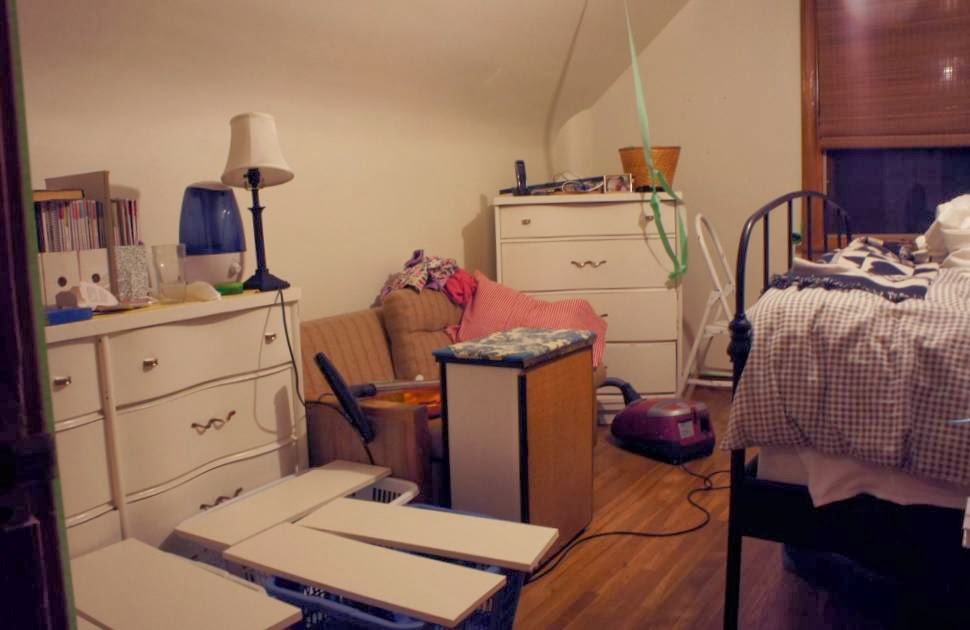
Yes, that is the state of my bedroom, right now. I am in the middle of painting it--one of many goals for this month.

I had divided them up into three categories: Home, Health, and Hobby.

As far as the home goals go, I've only managed to start on the painting one, as you can see. But truly? That'll be enough. I've had some lovely weeks with less than twenty hours of work scheduled--but that will come to end rather soon.

My main push has been to establish some healthy habits using the MMEW Jumpstart Class to propel me onward. It's working!


I'm exercising.


Making my bed (ever since I read about the relationship between will-power and tidiness.)

yes, pulling up the covers totally counts
 

keeping a "five minute" journal

--all I have to do is write in it for five minutes before bed. I am finding this oddly comforting. I used to keep a journal....but I found it too cumbersome to keep up once I had kids. It turned into laments and lists. This time, my focus is on small wins.


Isn't it gorgeous? I bought it as a gift for someone--and then decided to give it to myself!
 
 
And, here we are, Day 14 of the Whole30.


As for my hobby, scrapbooking, I'm a bit taken aback that I haven't accomplished even one thing, yet. I haven't even taken any steps towards accomplishing anything. This is going to get away from me super-quick if I don't do something soon.

So, that's where I'm at, 15 days into January. How are you doing with your goal(s)?


Monday, January 6, 2014

Willpower and Tidiness

My grandmother was right.


 I really do need to make my bed everyday. But that I need to make it so I can lose weight (or do any other task requiring willpower) is a bit of an eye-opener!

Another simple old-fashioned way to boost your willpower is to expend a little on neatness. As we described in Chapter 7, people exert less self-control after seeing a messy desk than after seeing a clean desk, or when using a sloppy rather than a neat and well-organized Web site. You may not care about whether your bed is made and your desk is clean, but these environmental cues subtly influence your brain and your behaviour, making it ultimately less of a strain to maintain self-discipline. Order seems to be contagious. p. 252, Willpower by Roy F. Baumeister and John Tierney (2011: Penguin)
In Chapter 7, Tierney and Baumeister write, "When offered snacks and drinks, people in the neat lab room chose apples and milk instead of the candy and sugary colas preferred by their peers in the pigsty." (p. 156)

As well, it turns out that once you expend some will power putting good habits into place (and vanquishing bad ones) not only does life go a little more smoothly (avoiding those crises which require self-control to get through well) but it conserves your will power so that when the inevitable storms do hit you, you can weather them better.

This makes intuitive sense when you consider the tenure track professor, as they do. Those who wrote when they had bursts of inspiration tended not to get tenure as much as those who plodded along, writing or researching a bit every day. In fact the correlation between self-control, habits and desired oucomes was strongest for working and study habits--and weakest for dieting and exercise.

However, the idea of establishing certain habits to make the effort easier-- the more automatic something is, the less will power it takes to do it-- is worth exploring.

Some habits to develop (and some to continue):

1. Make the bed every day. (Just 'cause.)
2. Do the dishes before going to bed. (So the counters is clean and making breakfast is easier)
3. Put on my work out clothes every morning. (So I don't have to think about going back upstairs)
4. Tidy the living room before bed. (So there's room to move.)
5. Menu plan. (I could even expand this to include all my meals for the day, not just supper.)
6. Write it down. (I am actually keeping a "five minute" journal this month where I just take five minutes to write down how my day went with respect to sticking with the Whole30. Again, another idea from Willpower. Tracking --of any and all kinds-- is good.)


What habits would you put into place to make it easier to achieve your goals?

Sunday, October 20, 2013

Day 20: Proactive and Reactive Strategies

Remember when we talked about your comfort zone and the organizing comfort continuum way back at the beginning of the series?

The continuum:

very cluttered -- slightly cluttered -- real life -- company ready -- magazine ready.

Your comfort zone is where any particular room falls on the continuum when it is the way you like it. Different rooms may land at different spots. For example, I am OK with my living room being slightly cluttered--but I prefer the area next to my kitchen sink to be as close to company ready as often as possible. (Which seems to be for about ten minutes a day right now, but I'll take it!) 

Reactive Strategies

Then, there are those areas where it's OK to let things go for a while. For me, that's the shelves in a particular closet, the basement, and the laundry room.


These areas can hang out in the land of "very cluttered" until I have the time and inclination to tackle them. That's being reactive: but it's OK. As long as I don't let things get so out of hand (though I think the laundry room is just about there) that it becomes impossible to do laundry or find clean clothes, waiting until this room needs my attention means I can focus my limited time on the areas of the house that affect my happiness much more.

Proactive Strategies

These areas, the ones I don't want to let get too far from my happy place, are areas where I need to be proactive. That is, I need to take action while they still look pretty good. For years, I ignored my dishes until we had run out and there was no counter space left to cook. I used to joke that I could cook supper in a space no bigger than two inches by two inches. When I couldn't stand it any longer I would do the dishes in an angry, resentful huff: it was unpleasant for everyone. Being reactive in this area of the house doesn't do anyone any favours. It is best to tackle this area, well, as often as possible.


I always dither when there are so few. However, I had a thought: if we had a dishwasher, would I put these into it? The answer was yes.

So, a mere five minutes later, I had this.


Being proactive in keeping an area organized (or clutter free) requires two things:
  • establishing a time to routinely move the areas back into their comfort zone, and
  • making "staying organized" part of a daily and weekly routine.

In other words, it's going to take some time--deliberate, focused, intentional time to re-set those areas of my home that I want to keep looking tidy and picked up. I don't know how I missed this piece of the puzzle: but I did. I would clean the house for days and get the house looking great only to watch it disintegrate out of the corner of my eye while I read, or stayed on the computer, or took on a time consuming project. But, no more. (I hope.) No, to stay organized I need to devote some consistent time and energy.

So, let's put this idea into action.

Where?
Identify the places in your home where you want to be proactive.
For me, that's my kitchen counter and my desk where the computer lives.

What?
Make a list of the essential tasks you want to tackle in these areas.
So, for example, I want to do the dishes and put things away after I take them out. (There's more, but that's enough to get started. Remember, it's not about performance, but about consistency, right now.)

How often?
I want to do those dishes after every meal, at least. I may use my "dishwasher" question in the future to help me decide whether to do them.
As for the desk and computer area, I want to re-set it once a day.

When?
As I've mentioned before, I want to "finish the day" every evening--basically, do a pick up and tidy every night before bed.

Developing these routines into a habit will require identifying a cue and a reward.  I'm still working on it.

The way my desk greeted me this morning.


ETA: You can catch all the posts in the series here. 

Saturday, October 19, 2013

Day 19: Habits and Rewards.

Rewards are an integral part of a habit: in fact, it may be that we perform the habit just for the sake of the reward.

This is powerful knowledge to have when trying to change a habit--simply keeping the cue and reward the same, but swapping out the behaviour (or routine) in the middle is a sure-fire way to change a habit. You have to be careful, though! In two days, I will celebrate my fifth anniversary as a born-again non-smoker. One of the "rewards" of smoking, for me, was the feeling of having something in my mouth. I substituted putting food into my mouth for drawing smoke into it. a-hem. Not a good substitution! Now, I try to use water.

The best rewards, of course, are attached to the habit itself: but it doesn't have to be, especially when you are trying to develop a new habit.

what will greet me in the morning


Yesterday, we talked about creating a cue for dealing with my paperwork. But what is my reward?
In time, perhaps, it will be a nicely cleaned out paper tray, but for now, while I am developing the habit, five or ten minutes on pinterest would be a lovely reward.

I am trying to develop another habit.

When I decided to implement Aby's advice to "finish the day" I realised I had to establish a new habit of tidying and picking up at the "end" of my day.

It is going to take me some time to turn the evening routine into a habit. It has taken me months to get into the groove of doing my dinner dishes--I still don't have a proper trigger for them. (Right after we finish supper is not a great time for me. I like to stay off my feet and relax!) I just wander into the kitchen at some point in the evening and, if no one is in the shower right then, I do them.

Here's what I want to do:

  • wash dishes
  • re-set the kitchen (wipe counters, wipe stove, clear off the kitchen table.)
  • put away what I took out today and what came in today (including the groceries. All of them. ack.)
  • set up the coffee pot for the morning
  • re-set the desk
  • tidy up any on-going projects (Be done back entry way project, be done and be gone!)
The reward? Going to bed.
In truth, the reward comes the next morning when I greet a tidy house with fresh coffee.

I will let you know how it goes.

ETA: You can catch all the posts in the series here.

Thursday, October 17, 2013

Day 18: Habits and Cues


Yesterday, I delineated the actions I needed to take to use this paper system properly. I have to look at the papers in the top tier everyday, the second tier on Tuesdays and Thursdays, and the bottom two tiers on Thursdays.

The question remained: how was I going to remember to do that?

That brings us to the fascinating topic of habit creation.

According to Charles' Duhigg who compiled the research on habits into an engaging narrative in The Power of Habit; Why We Do What We Do, a habit consists essentially of three parts: a cue, a routine, and a reward. (There are great resources, including a flow chart here.)

I'll let him explain. In this short three minute video Duhigg talks about how he changed one of his own habits:


To create a new habit, the first thing I need to do is to create a cue or trigger--in other words, the reminder.

I could
  • send myself a memo via my e-mail. I use Memo to Me to help me remember to do the budget on Thursdays.
  • set an alarm on my phone (I would if I had one of those!) A fellow at work uses one to tell him when his lunch time is over. It goes off about five to seven minutes before he has to return to work and it sounds like the warning for a nuclear meltdown.
  • perform the new routine or habit right after I'd finished another habit: finishing the previous habit becomes the cue for the next one.

Placing a new habit right after an existing one is, in fact, probably the easiest and the most natural way to create a new habit.

For example, to create a new habit in the morning, create a list of those things which always happen in the morning. Then, sandwich your new habit between events that happen all the time. A visual reminder of some kind wouldn't hurt either. Then, if you like, create a checklist with the new routine.

Scheduling the habit and then doing something, any small thing, really is almost more important to the development of the habit than anything else.

For example, take my paperwork. (Please!) I've decided that bringing in the mail will be my cue to look at the stacks. For now, my only "task" associated with the stacks is to deal with one piece of paper--from any of the slots. That's it. I want to make it as easy as possible. I want to take such a tiny bite that it would be ridiculous to refuse. Once I have the two actions paired: get mail, check paper slots, and that's automatic, then I can do a more thorough job on the slots.

Tomorrow, we'll talk about the reward.

ETA: You can catch all the posts in the series here.

Wednesday, July 14, 2010

Interlude: Musing on Habits


Aby Garvey's newsletter today discusses habits as "the key ingredient" to staying organized. I think she's right.

She challenged us to think about how habits and how they influence our clutter: these are my thoughts.


1) Which specific habits are causing my clutter?

Is not doing something a habit? While it seems odd to say so, isn't it so? What's procrastination but a) not doing something and b) a bad habit? (At least that's what my Grandmother always told me!)

Tiredness. I should put my clothes on the couch when I go to bed--not on the floor! I should also be making my bed and throwing in a load of laundry when I wake up. Yawn. I'm often just grateful I'm awake before noon.

I hate folding laundry, too. I avoid it. I'm not sure why. True, the laundry room is dark and freezing cold in the winter. (I tried running a portable heater, but blew a fuse.) It's a long way from company and cheer--but I'm afraid that if I bring unfolded laundry out of the basement, I'll just perpetuate laundry clutter in the main areas).

2) Pick one habit to change.

Oh well, I have been starting a load, transferring one and folding one pretty much everyday since we got back. I think I'll keep it up.

3) Get support

OK.

4) Create a list of compelling reasons to change.

Maybe that's part of it. With respect to the laundry, I'm not really all that affected by whether it gets done or not. My wardrobe is very small. I collect my dirty clothes separately from the rest of the family. When I need something, I run a load and include it. I also think we have too many clothes, even though my husband never has a clean shirt for work and my son, right now, says he has no pants. The fact of the matter is, my son has a gazillion T-shirts and a couple of pairs of pants. So, it is entirely possible for me to do two loads of darks--and nary a pant leg nor a work shirt for my husband will emerge while doing the dreaded folding. I'm not sure what a "reasonable" amount of clothing is--but it's something to look into.

One compelling reason?
I don't want anyone telling me they "can't" do something because they don't have whatever it is they need to wear. No more complaining. No more yelling. No more icy trips to the basement on the edge of my toes to retrieve socks and underwear.

I think I'll also train the kids to take over some days....

5) Decide up front to stay the course.

OK. However long it takes, I'll stick with this. However long it takes--to do what exactly? Stay on top of the laundry? See, this chore, this habit (like the other bugaboo, doing the dishes) never ends. There is no "over." There is no "done." No completion.

I hate that.
Related Posts Plugin for WordPress, Blogger...